Machine Stitched Book Pages

Today I started working on my machine stitched book that I am making for homework for my last Level 2 Stitch Class. I finished two pages. The book needs to be 5 pages long so I have three more pages to make and then the binding. I also added a bit more dark red to my painting from yesterday.

 Here is the first book page. It is a combination of automatic machine stitches worked in patterns. These pages take a long time due to all the starting and stopping.

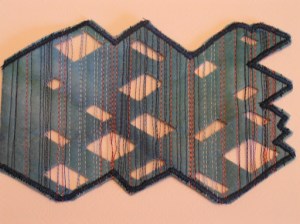
Here is the second book page. This one has the holes cut out first and then you stitch through lines across the piece right through the holes. Then I edged it with satin stitch. It looks a little wonky but it sort of turned out as I expected.

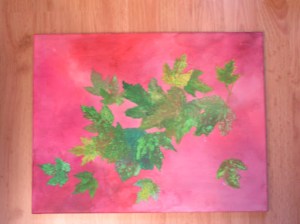
Here is the leaf painting again. I added another coat of red to the background. It is slightly darker than the photo shows. It is so hard taking a photo of red. The camera doesn’t seem to know where to focus. I also made a short video of my bead book. I am going to try and edit the video and post it on the Felting and Fiber Studio site tomorrow. Hopefully that won’t be too painful!

Painting Party

I met with my local art group today and we played with layered painting. I somehow forgot to take any photos while they were here. So all I have to show is my painting which is nowhere near finished.

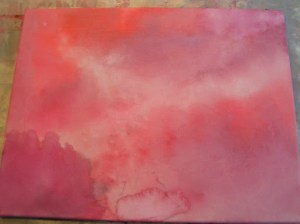
 This is where I started with a fairly light painted background.

Here is what I finished today. There are two layers of leaves on here but I haven’t gone in and painted into the background. I need a lot of work to get darker values of red and to make the different layers of leaves show better.

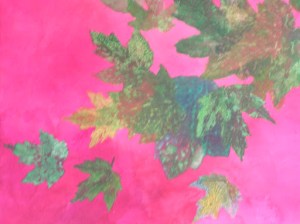
Here’s a closer view. I love how the gesso under the paint shows through and gives texture to the painting. I have a lot more work to do on this one.

Interlaced Insertion Stitch

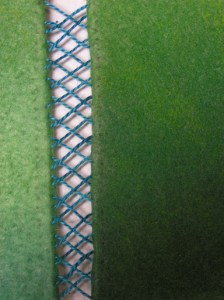
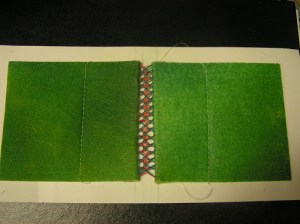
Today I tried the interlaced insertion stitch. I found it painful. First you do a double herringbone stitch between the edges and then you interlace it. When you do the herringbone, there is a certain way you are supposed to take the threads underneath each other as you stitch. I think I did this part wrong because when I tried to interlace following the instructions, it didn’t work. I had to go in different directions to make it work than what the instructions showed.

 Here is the double herringbone. I decided to take the stitch right through the fold. That was my first mistake.

 I did mark little dots so I could get the stitch even.  I had difficulty tying the ending knot in the fold. If I do this again, which is doubtful, I would take a stitch in the edge.

 Then I took an orange thread and interlaced the herringbone stitch. Here it doesn’t look so bad.

 But when you look in a closer view, the interlacing is really messed up.

The instructions said to use a thinner thread for interlacing but I think size 12 compared to size 5 was too much of a difference. I have tried all the interlacing stitches so next up for these little books is putting in pages. I have several ideas of how to do this so more sampling to come.

More Insertion Stitches

I tried two more insertion stitches today. The first one was simple and is called twisted insertion stitch. The second one, plaited insertion stitch was not so simple. It took some effort to figure the stitch out and then I had to keep looking at the instructions again and again. But it looks really neat when completed.

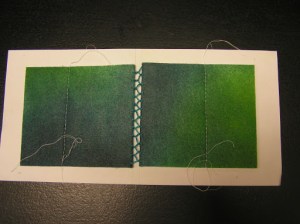
 This is the twisted insertion stitch. For all these stitches, you baste your two pieces of fabric to card stock to hold them in place. That way you will end up with an even space between the two pieces of fabric.

 Here is the little book folded.

 Here’s a closer view of the stitch.

 This is the plaited insertion stitch. I like how the stitch looks but I don’t like the ending and starting points. You can see in this photo how there is only one strand at the top left and then all the rest have three strands of thread? It just doesn’t look right. But that is how you are supposed to start the stitch.

 I decided to fix that after I finished the row of stitches. I put my needle back in just under the first thread.

 Then I “plaited” the thread. It’s just like weaving, over and under the threads with your needle. Make sure not to pierce the threads as you are weaving through them.

 Then take a stitch on the opposite side.

 “Plait” the thread back through with under, over under.

 And then take the stitch back through the other side and tie off. That is essentially how you do the entire stitch but it is really easy to get confused with this one.

You can see that the tension at the top is a bit loose. Next time, I will use a thinner thread, I used size 5 perle cotton here, put the two pieces of felt about 1/2″ apart instead of 3/4″ and try to get better tension.

I’m not sure that this makes a really functional book binding because of the way the stitch starts and ends. But perhaps I can work it out to make it sturdier at the ends. I have one more insertion stitch to try, it’s called  interlacing insertion stitch. It is made up of a double herringbone done between the two pieces of fabric which is then interlaced with another thread. I don’t have two types/colors of thread with me today so I’ll try that one tomorrow.

Working Italian Insertion Stitch

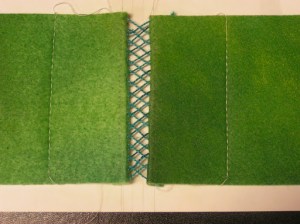
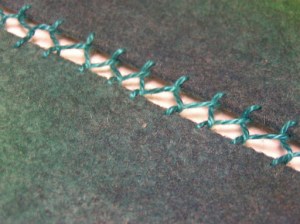
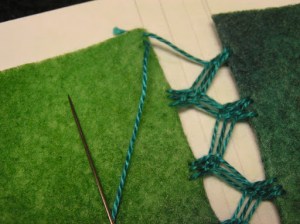
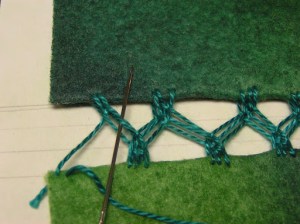
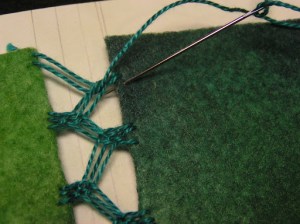
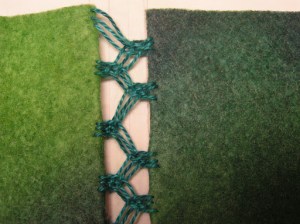
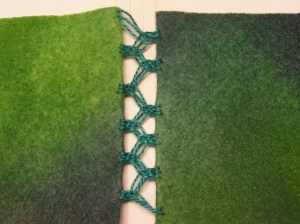
I got started working the Italian Insertion Stitch. It is actually fairly easy once you get started. It looks complex but is made by alternating buttonhole stitches on each side at an angle and then covering the prior buttonhole stitch with four detached buttonhole stitches.

The top three stitches are a bit muddled but then it got better after I got started. I actually think this would look better if I had left more space between each stitch so you could see more of the diagonal movement of  the stitch. I really like these insertion stitches. They were originally used to insert fancy pieces of fabric into clothing. But they make excellent bindings for small books. I want to use insertion stitches with hand made felt books. More of these to come!